


Border Crossings Hit Record High in 2025, Approaching 700 Million
Share on wechat
×
Use wechat to "scan" to share the web page with your wechat friends.
The National Immigration Administration (NIA) held a press conference on January 28, releasing key data on immigration management for 2025.
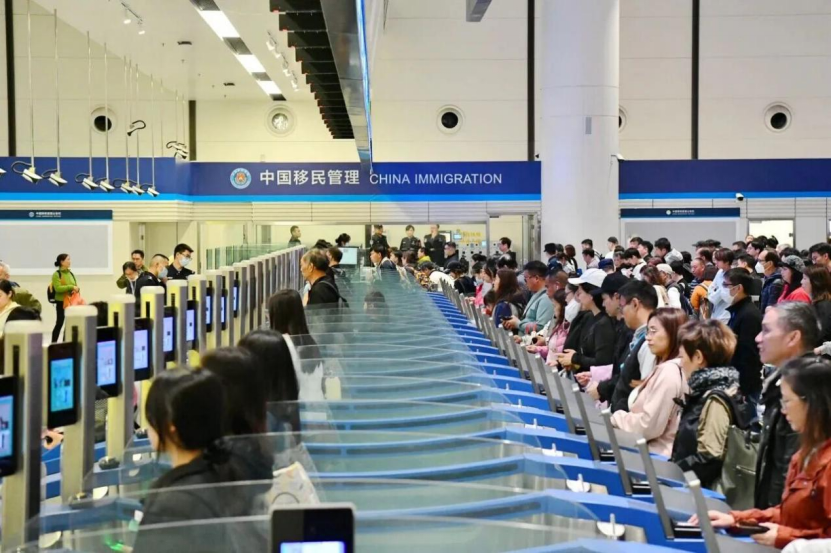
On March 16, 2025, the Liantang Port in Shenzhen, Guangdong, saw over 110,000 inbound and outbound travelers, setting a new single-day passenger record since its opening.
In 2025, immigration authorities nationwide inspected a total of 697 million inbound and outbound travelers, a year-on-year increase of 14.2 percent, setting a new record. The breakdown includes 335 million residents from the Chinese mainland (up 15.1 percent), 279 million residents from Hong Kong, Macao, and Taiwan (up 10.1 percent), and 82.04 million foreigners (up 26.4 percent). Among foreign arrivals, 30.08 million entered under visa-free policies, accounting for 73.1 percent of all foreign entries and representing a 49.5 percent increase year on year. Immigration authorities also inspected 38.12 million means of transport (up 17 percent), including 1,006,000 aircraft (up 14.5 percent), 107,000 trains (up 5.9 percent), 459,000 vessels (up 4.9 percent), and 36.54 million motor vehicles (up 17.3 percent).
Throughout 2025, the NIA focused on supporting economic growth and facilitating both inbound and outbound flows, continuously deepened immigration management reforms, and introduced institutional innovations to enhance its service efficiency. Throughout the year, it issued 20.90 million ordinary passports, processed 98.54 million travel permits and endorsements for mainland residents to visit Hong Kong, Macao, and Taiwan, issued 2.25 million travel permits for residents of Hong Kong, Macao, and Taiwan to visit the mainland, and issued 2.02 million visas and residence permits for foreigners. The NIA’s online government service platform handled 185 million inquiries and service requests, offering 76.33 million free identity verification services to compatriots from Hong Kong, Macao, and Taiwan, overseas Chinese, and foreign permanent residents. The 12367 immigration service hotline handled 7.11 million inquiries with an average satisfaction rate of 99.5 percent.
To facilitate international personnel exchanges, the NIA expanded the pilot program for fully online renewal and reissuance of travel documents for mainland residents to 50 cities. It added Indonesia to the list of countries eligible for the 240-hour visa-free transit policy and designated five additional ports in Guangdong for the policy, bringing the total number of eligible ports to 65. It implemented a visa-free policy for tourist groups from ASEAN countries visiting Xishuangbanna in Yunnan. In collaboration with relevant authorities, it helped expand unilateral visa-free entry to 48 countries, mutual visa exemption to 29 countries, and facilitate 28 countries to grant unilateral visa-free status to Chinese citizens.

Staff at the immigration service station of the China-BRICS Science and Innovation Incubation Park for the New Era assist a foreign national with procedures, April 9, 2025, Xiamen, Fujian.
To promote the facilitation of border inspection and customs clearance, the number of ports allowing 24-hour direct transit without inspection procedures has been expanded. Across all passenger ports nationwide, a one-stop service for visa-free transit temporary entry permit acceptance and issuance, as well as entry immigration inspection procedures has been implemented. The electronic port visa was launched on a trial basis in Shanghai. Online Arrival Card filling has been promoted among international arrivals. The use of facial recognition for smart clearance has also been widely adopted. Rapid clearance systems for vehicles were implemented on a trial basis at the Hekou and Mohan ports in Yunnan, as well as at the Ganqimaodu Port in Inner Mongolia. The NIA also supported 24/7 freight clearance trials at Erenhot and other highway ports.